Friday, October 30, 2015

California Climate Investment Plan Draft Is Good Primer on California Strategies

California's climate strategy includes a robust cap and trade program that is generating billions of dollars.  The money is invested in climate solutions at a level surpassing climate investments by almost all national governments.  The California Air Resources Board is assisting the state Department of Finance in developing the latest version of a forward-looking plan for investing future revenues.

The 2015-16 California state budget allocated over $2.2 billion in cap and trade revenue to programs, ranging from $20 million for healthy soils to $350 million for low carbon transportation and $765 million for transit and rail projects.  Billions more in revenues are expected over the next few years.

The allocation of cap and trade revenue is subject to negotiations between the governor and legislature, but it is guided by an intensive review of potential climate investments in many program areas.  The review is mandated by legislation signed by Governor Brown in 2012 (AB1532, by Assemblymember John Perez).  The legislation requires regular preparation and updating of three-year climate investment plans for cap and trade auction revenues.

The California Air Resources Board has released the latest draft of the investment plan.  The plan will serve as background for the governor and legislature as they guide the expenditure of several billion dollars in auction revenue expected from 2016 to 2019.  Revenues will be used for a variety of public investments and incentives.

http://www.arb.ca.gov/cc/capandtrade/auctionproceeds/
draft-second-investment-plan.pdf


Hearings on the plan will take place in early November and comments will be accepted until November 13. A new draft will be released in early December, followed by another comment period and a hearing before the Air Resources Board on December 17-18.  The plan will be submitted to the legislature in January.  (Details on the hearings here)

The draft document, Cap-and-Trade Auction Proceeds Second Investment Plan:  Fiscal Years 2016-17 through 2018-19 (Draft) (linked here), includes detailed background and serves as a very useful primer on the California climate program and related investments/expenditures.  The plan has already been the subject of several workshops and over 200 written comments have been received to date (written comments can be viewed here).

The draft plan provides detailed background on the investment areas and programs.   There is also a good discussion of how investments will target disadvantaged communities, as required by state law.

The Air Resources Board staff has done an excellent job of preparing a series of graphics that provide an overview of the California climate program and related uses of auction proceeds.  Below is a selection of graphics covering the overall California strategy and summarizing expected investment areas for the next few years:


Overview of California Climate Goals for 2030:


Source: (10//27/2015 Draft) Cap-and-Trade Auction Proceeds Second
Investment Plan: Fiscal Years 2016-17 through 2018-19

Additional Detail on California Climate Goals & Targets Through 2050

Source: (10//27/2015 Draft) Cap-and-Trade Auction Proceeds Second
Investment Plan: Fiscal Years 2016-17 through 2018-19

CO2 Emissions at 2020, 2030, 2050


Source: (10//27/2015 Draft) Cap-and-Trade Auction Proceeds Second
Investment Plan: Fiscal Years 2016-17 through 2018-19

Overview Of Proposed Investment Areas


   Source: (10//27/2015 Draft) Cap-and-Trade Auction Proceeds Second
Investment Plan: Fiscal Years 2016-17 through 2018-19

Proposed Transportation Investment Concepts, Including Recipients


Source: (10//27/2015 Draft) Cap-and-Trade Auction Proceeds Second
Investment Plan: Fiscal Years 2016-17 through 2018-19

Proposed Energy Efficiency/Renewables Concepts Including Recipients


Source: (10//27/2015 Draft) Cap-and-Trade Auction Proceeds Second
Investment Plan: Fiscal Years 2016-17 through 2018-19

Proposed Resources/Waste Concepts Including Recipients


Source: (10//27/2015 Draft) Cap-and-Trade Auction Proceeds Second
Investment Plan: Fiscal Years 2016-17 through 2018-19

Proposed Transportation & Sustainable Communities Concepts Including Recipients


Source: (10//27/2015 Draft) Cap-and-Trade Auction Proceeds Second
Investment Plan: Fiscal Years 2016-17 through 2018-19


Monday, October 19, 2015

Small Bits of Climate Hope from Europe

I returned last week from a vacation in Europe.  We had a thoroughly enjoyable time hiking in the mountains of Tuscany and visiting our son in the Netherlands.

Climate solutions were not the intended focus of our trip, but I couldn't help but notice the many energy conservation and renewable energy efforts in the countries we visited. I came away feeling more optimistic that needed climate solutions are being implemented and can be accelerated.

Solar is much more commonplace than I expected. We spent a week in an Italian Agritourismo originally built in medieval times in a remote mountain area. It is now largely run by solar. In a neareby hillside village in the Garfagnana area north of Lucca, homes with photovoltaic panels are easily spotted.

Solar panels on homes in the hills of Garfagnana, Italy

Even very old homes are are adding solar as they are remodeled, as the home below shows.


In the small town of Maastricht in the southeastern corner of the Netherlands, homes have many energy conservation features such as motion sensors for lights, heavy insulation, CFL and LED lighting and efficient windows.  These simple features are common throughout the areas we visited in Europe.  Solar is also increasing, as the roof of the home next to our Bed and Breakfast shows.

Solar Panels on Roof in Maastricht, Netherlands

Our journeys between towns were on electrified trains that were reliable and generally faster that auto travel.  Electric cars and plug-in hybrids are becoming much more commonplace.  Paris has had an electric car-sharing program since 2011.  There are now about 3000 cars in the Paris program being used for over 10,000 rentals a day (source here).  The Paris program is now rolling out to other cities.  Paris also boasts a robust bicycle sharing program.

AutoLib Paris Shared Electric Cars at one of about 1000 charging locations
Tesla and one other car charging in Maastricht, Netherlands

Cars charging at train station in Dusseldorf, Germany
Often forgotten among the climate solutions are steps to reduce waste, recycle and compost.  Not only are resources used more efficiently, but greenhouse gas emissions from rotting garbage can be minimized or eliminated with proper management.  In Florence, Italy, there are separate streetside bins for organic waste and recyclables, offering residents a convenient way to assure proper handling of materials.

Food and organic waste collection bin on street in Florence, Italy

Recyclables collection bin on street in Florence, Italy

These are just a sampling of the measures we saw.  Windmills were seemingly everywhere, as were larger solar installations.  Passive solar design is incorporated in buildings,  LED lighting is becoming widespread.  Bicycle use is emphasized through workable bike lanes bike share availability.

The nations of the world will be gathering in Paris in early December to craft agreements with the goal of keeping temperature rise under about 3.6 degrees farenheit in the coming decades.  To be successful, sweeping changes in our approach to energy production, transportation systems and resources utilization will be critical.  But rapid implementation of the large-scale solutions will require many small scale actions by communities and individuals.  

Our recent trip to Europe helped convince me that the needed steps are taking hold in many areas.  With aggressive commitments and incentives for governments, it will be possible to take both the large and small steps needed to slow and eventually stop climate change.

I'll be returning to Paris for the U.N. Climate Summit in December.  


Monday, September 21, 2015

California Climate Solutions: BioFuels

BioFuels Contributing to California Climate Goals


Ethanol from sugar cane and sorghum.  Diesel from waste vegetable oils.  Natural gas from food and yard waste.

These are just a few of the green fuels that are in the process of commercialization in California.

A key "pillar" in Governor Brown's California plan to reduce greenhouse gases by 40% by the year 2030 is to cut fossil fuel use in the transportation sector by 50%.  As I described in a prior blog post (California 2030 Climate Goals:  Transportation Fuel Use), the fossil fuel reduction goal is attainable with current technologies through a combination of electric/hydrogen vehicle deployment, efficiency improvements, expanded use of alternative transportation modes, and noticeable increases in the use of low carbon fuels.

Relative carbon intensity of current standard diesel fuel (ULSD) and
various substitutes.  Source:  ARB 2/19/15 Presentation

While electrification of the transportation sector remains a central policy goal of the state, there will continue to be some transportation modes that will be slower to electrify, including long haul trucks and other non-automobile vehicles and equipment.  In addition, traditional and hybrid cars will continue in use for the foreseeable future.  Vehicles that traditionally used fossil fuels can still contribute to the state climate goals through the use of renewable fuels.

For several years, the California Energy Commission (CEC) has been providing strategic grants to assist in the commercialization of alternative and renewable fuels.  The grants are a real climate success story.  With CEC assistance, many companies are now providing low-carbon fuels for direct use or to blend with existing fuels to lower the carbon intensity and climate impacts.  

Several of the projects were highlighted at a recent workshop convened by CEC Commissioner Janea A. Scott.

Harry Simpson of Crimson Renewable Energy said their facility in Bakersfield is the largest biodiesel plant in California.  They use used cooking oil, inedible corn oil from ethanol plants and animal fats as feedstock, but could use other sources in the future.  They are in the process of expanding their plant from 10 million gallons per year capacity to 22 million gallons per year.


Harry Simpson, President
Crimson Renewable Energy 9/18/15

Mr. Simpson cited state policies and incentives as key to their ability to expand production.  One of the policies is the state "Low Carbon Fuel Standard" (LCFS).  The LCFS is in the process of being renewed by the California Air Resources Board.  He also said that crops could be used as a feedstock for renewable diesel, but there are challenges assuring a consistent and adequate supply.  He said that some of these challenges could be overcome if there were a crop insurance program available for energy crops.

Susan Kennedy of South San Francisco Scavenger Company and Evan Edgar of Edgar and Associates described facilities to take food and yard waste and convert it to fuel and compost.  As the graphic below illustrates, food and yard waste would go through an anaerobic digestion facility.  Biogas would be processed and used by the trucks of the local waste company and displace traditional fossil-fuel based natural gas.  Residual material would become compost to use on farms.  The farms could grow food and the waste products from the food preparation could again be used as feedstock for fuel and compost.

Source:  Edgar/Kennedy Presentation to California Energy Commission 9/18/15


Mr. Edgar said that any community of 100,000 or more people could support an economically viable facility.  He said that the fuel used by the trucks would be "carbon-negative" based on the carbon calculation methodologies approved by the Air Resources Board.  Using the community size of 100,000 as an example, Mr. Edgar said a facility in such a community could produce enough fuel for a fleet of 35 waste/recycling trucks that would normally use about 330,000 gallons of fuel in a year.  Ms. Kennedy pointed out that, in addition to all the other benefits, their facility will help her company achieve their goal of reducing waste going to landfill.


Susan Kennedy, Evan Edgar and Paul Relis 9/18/15

Paul Relis of southern California waste management company CR&R described their anaerobic digestion facility under construction in Perris, California (Riverside County).  Their facility will be larger than the ones previously described.  The gas will be used to fuel about 70 CR&R trucks and they plan to have a system in place to clean and condition the gas so it can be injected into the local natural gas pipeline for residential and commercial use.

CR&R Faciity.  Source:  CR&R CEC Presentation 9/18/15

Projects like these benefit from a range of California policies and incentives, including the Low Carbon Fuel Standard which the Air Resources Board is scheduled to update in a few days.  The Energy Commission continues to put in about $20 million a year to support biofuels.  As of early this year, they had supported 45 projects with $135 million.  The Energy Commission expects to enter into a new funding round for projects later this year.

Source:  California Energy Commission Investment Plan Update April, 2015

BioFuel proponents are hoping for additional funds to accelerate commercialization of biofuels.  The source most often mentioned is the California Cap and Trade funds.


More Information:

California Energy Commission Renewable Fuel Program
ARB Low Carbon Fuel Standard Program
UC Davis Status Review of California LCFS
BioEnergy Association of California
California BioDiesel Alliance

Monday, September 7, 2015

"Clean Coal" - This Hydra Needs to Die

Presidential Candidates Promote Damaging Energy Source


In Greek mythology, the Hydra is a creature that belches poison gas and sprays caustic blood when injured. And, every time you try to kill it by chopping off the head, two more heads grow to replace the lost one.

According to one description, "this monster was so poisonous that she killed men with her breath, and if anyone passed by when she was sleeping, he breathed her tracks and died in greatest torment."

Hydra: Digital image courtesy of the Getty's Open Content Program

"Clean coal" reminds me of the Hydra.  Just when you think it has been slain in favor of better technology, the ugly head of  "clean coal" resurfaces and seems to multiply.  Clean or not, coal breathes noxious gas into the atmosphere and bleeds poisonous materials like mercury.

I'm not the first to see this analogy.  Mat McDermott discussed the clean coal hydra in 2008 here.  I'm sure others have too.

"Clean coal" is a mirage created by a coal industry desperate to revive an energy source that has no role in a climate challenged world.  Despite billions spent chasing the technology, it remains elusive, unproven and unreliable, while giving some a false hope that coal can be cleaned and the carbon emissions captured and stored or neutralized.  The reality is that "clean coal" is a distraction from the truly clean technologies that must be deployed to address climate change.


The latest "clean coal" hydra-head emerged from Republican Presidential candidate Carly Fiorina.  In response to questions about climate change, she has delighted climate deniers by dodging the issue and saying there are dozens of priorities more important than thinking about climate.  She is quick to promote "clean coal" and trash other technologies like wind and solar. "To say we’re basically going to outlaw coal, which is what this administration is doing, is so self-defeating. It destroys jobs, communities," Fiorina said in an interview with Katie Couric. She worries that China is going to get ahead of us in pursuing clean coal unless we start pushing clean coal technologies.

"Carly Fiorina (13045502775)" by Gage Skidmore from Peoria, AZ, United States of America
Licensed under CC BY-SA 2.0 via Wikimedia Commons 

"Clean coal" isn't a new concept for Fiorina. In her failed California Senate race in 2010, she said, "We also need to use every source of energy we have, including nuclear power and natural gas to reduce our dependence on oil from other countries. At the same time, we need to build on advancements in technology that make clean coal more affordable and more realistic." (source here)

What is new for her is a series of mis-informed attacks and outright lies about clean energy such as solar and wind (see detail from David Roberts on Vox here). She says she is uncomfortable with solar because of the huge amounts of water it consumes and wind due to bird kills. (Never mind that solar panels use no water and wind technology has advanced to the point where cell phone and radio towers are 10 times more dangerous for birds.)

Ad in Wall Street Journal May 9, 1979


Fiorina isn't the only candidate promoting coal, "clean" or otherwise.

Candidate John Kasich says of coal: "we are going to dig it, we are going to clean it, and we are going to burn it in Ohio, and we are not going to apologize for it." (source here)

"Obama’s war on coal is killing American jobs, making us more energy dependent on our enemies & creating a great business disadvantage" says Donald Trump (source here)

"Donald Trump Laconia Rally, Laconia, NH 4 by Michael Vadon July 16 2015 19"
by Michael Vadon - Own work. Licensed under CC BY-SA 4.0 via Wikimedia Commons 

“When it comes to coal, there is no industry in this country that has been more of a target of an outright assault from the federal government than has the coal industry" said Ted Cruz in Wyoming (source here)

"God blessed America with abundant coal, oil and natural gas. Let's open up more federal lands for safe and responsible exploration." said Marco Rubio in Iowa (source here)

Coal Plant; Source: USGS

"... we should utilize our existing coal reserves cleanly, both through our existing plants and through the development of new cleaner coal technologies," says Bobby Jindal in a report on energy (source here).

Jeb Bush recently met with CEOs of coal companies (source here) and got a financial boost from "King Coal" (source here)

Scott Walker "has not made climate change a focus of his campaign, but he has spoken at the Heartland Institute, a group that denies man-made climate change. Walker also joined more than a dozen other coal-reliant states suing the Environmental Protection Agency to block the so-called Clean Power Plan" (source here)

Like the mythical beast, the modern "clean coal" Hydra threatens the world with fumes and poison.  In mythology, a giant crab defended Hydra.  Today, it is a group of misguided politicians helping a desperate coal industry survive.  In mythology, it took the cleverness of Hercules to slay the Hydra. Today, it will be the ingenuity of the renewable energy industry that slays coal through cost savings, environmental benefits and technology that works.

Hercules slaying Hydra; Beham 1545;  ©Trustees of the British Museum


Addendum .... Despite the seriousness of climate change and the threats from continued use of coal, it is possible to maintain some humor, as evidenced in this clean coal "ad" produced by the Coen Brothers in 2009:


Monday, August 24, 2015

Some Recent Climate Change Videos I Liked - August 2015

Climate Change, Consumerism and the Pope


Synopsis from UCTV:  After being summoned to the Vatican to advise on climate change, Dan Kammen of UC Berkeley shares an insider's view on what inspired Pope Francis to issue such a passionate plea to protect the earth in Laudato Si, his 2015 encyclical on the environment. As a practicing Catholic, former Michigan Governor Jennifer Granholm (now with U C Berkeley Energy and Climate Institute) praises the Pope for presenting "human ecology" as a moral issue in this lively exchange with Kammen and Henry E. Brady, dean of the Goldman School of Public Policy at UC Berkeley.

This video is about 28 minutes .. if you want to watch the 1 minute 20 second synopsis, click here.


Cap and Trade Simplified


New media website CalMatters provides an animation overview of the California Cap and Trade system.


Climate Change Affecting Wine Grapes


Al Jazeera America Reports on how the wine grape industry is impacted by climate change.


Climate Change and California's Dying Forests


Canadian network CBC reports on how climate change is impacting California forests.


Climate Change and Lake Mead


Pat Mulroy, former general manager of the Southern Nevada Water Authority, talks about the growing water crisis in the West, where Lake Mead is now at its lowest level since the Hoover Dam was built in 1939.  Mulroy is now associated with the Brookings Metropolitan Policy Program.


Carbon Negative Fuels


Evan Edgar of Clean Fleets talks about carbon-negative fuels and California Cap and Trade.


Tuesday, August 11, 2015

Traitors to Humanity

I consider myself an optimist.  I believe people are generally good hearted, honest and well meaning.  I believe world leaders will finally recognize that climate change must be addressed and must be addressed quickly.

My optimism is validated by recent climate actions of President Obama, Pope Francis and others.

However, my optimism is tempered by the scientific reality and the persistent denial from leaders who know better.

The problem is that quick climate action is now defined as taking steps that will limit global warming to about 2 degrees centigrade.  We're already at about a .8 degree increase and we're seeing impacts: more frequent and intense extreme weather events; melting ice in the Arctic, Antarctica, Greenland and glaciers; rising sea levels impacting low lying coastlines; increased droughts; and, the first waves of climate refugees escaping climate impacted areas.

The United States Environmental Protection Agency estimates that the 2 degree limit will help to mitigate sea level rise, but we’ll still see an increase of a foot or more in my lifetime and over 3 feet by the end of the century.  That means a lot more human, environmental and economic hardship could face humanity in the coming decades.

The optimist in me believes we'll find ways to cope with the changes, but we better not let it get any worse than a 2 degree increase.  Anything above 2 degrees and the scientists tell us that we could get into an irreversible acceleration of impacts that will ultimately raise seas to levels unseen in human history and make large portions of earth uninhabitable.   Some scientists are now questioning whether 2 degrees is the right number or whether the cap should be much lower to avoid the worst devastation.

The potential for climate change has been known for many years.  In the 1980s, the science became clear enough that our leaders should have taken steps to limit global warming to a much lower level than 2 degrees.  But they didn't.  In the 1990s, then President George H.W. Bush and other Republican leaders took some preliminary steps to begin to address climate change. 

But then fossil fuel companies and their surrogates convinced some politicians and opinion leaders that the climate solutions would hurt their business interests.  They funded some of the same public relations and psuedo-scientists who were used to delay regulation of cigarettes and toxic chemicals.  They created doubt about the science and provided cover to Congressional leaders who wanted to placate their oil patrons.  Their work was surprisingly successful.  According to polls, only 50-some percent of Americans believe there is a scientific consensus on climate change or that we are already seeing impacts.  And Americans are among the least informed on climate of the major industrialized countries.  The reality is that over 99% of climate science studies agree there is a problem and scientists are telling us it is already affecting us.

By the early 2000s, opponents to climate action convinced the Republican leadership that climate could be used as a partisan issue.  With some exceptions like Senator Lindsay Graham of South Carolina and former Ronald Reagan Secretary of State George Shultz, most Republicans who previously believed action on climate was needed, back-peddled.  Then, one very conservative Congressman, Bob Inglis of South Carolina, looked at the science carefully and realized earth was in big trouble.  He started advocating for climate change action and, as a result, conservative activists rallied around a Republican opponent who soundly defeated him.  The message to Republican members was clear -- back climate science at your own peril.  

Opinion polls in the U.S. now reflect a sharp partisan divide on climate, with Democrats much more likely to believe climate science than Republicans.  The Public Policy Institute of California released a poll last month showing California Democrats twice as likely as Republicans to believe climate impacts have already begun (73% vs. 37%) and more than twice as likely to see global warming as serious threat.

Source:  Public Policy Institute of California Survey Californians and the Environment July 2015


Climate deniers among the Republican Presidential candidates and in Congress have been emboldened and continue in their efforts to dismiss scientific reality.  Despite overwhelming irrefutable evidence, they continue to resist needed action.

I was thinking about the future recently and wondered how the climate deniers will be remembered in the future.  The deniers have managed to stall climate action for several decades.  I believe their days of obstructionism are waning in the face of public and world insistence for action – that’s the optimist in me coming out again. 

But these climate deniers will be remembered in the future for their tremendous success at obfuscation and delay.  And this remembrance will not be a positive one.  I expect people in the future will look back in anger at our failure from the late 1980s to 2015 to take steps to limit global warming to a level lower than 2 degrees centigrade.

People in the future will want to know who was responsible for inaction.  And, for the displacement, environmental damage and human suffering, those responsible will be remembered with disgust and disdain.

Others have used the phrase “traitor to humanity” to describe leading climate change deniers.  Traitor is a harsh word, but I can think of none better to describe the reckless disregard for our planet and the humans that live on it.  For a bit of political self-gratification now, the climate denial leaders are condemning themselves to be forever remembered as betraying humans and the planet.

Thursday, July 30, 2015

California Coast: Get Ready for Sea Level Rise

Adaptation.  Resilience. Readiness.

Whatever you call it, it's time get our coastline ready for this "slow moving emergency."

Active bluff failures at Fletcher Cove, Solana Beach
"Solanabeach-activeblufffailures" by Stickpen - Own work. Licensed under Public Domain via Wikimedia Commons

Sea levels are rising in California as they are throughout the world.  To date the rise has been measured in inches, but it will increase noticeably  in our lifetimes.  What we know and enjoy along the California coastline is going to look a lot different over the next twenty to eighty years.

The United States Environmental Protection Agency recently released a report, Climate Change in the United States:  The Benefits of Global Action.    As world leaders and scientists gravitate towards solutions aimed at capping world temperature increases at 2 degrees centigrade, the EPA report shows the benefits of action, including lessened risks to health, the environment, infrastructure and other sectors.  However, the EPA report also shows that even with a world agreement, we're still going to see big impacts in the U.S. and we're going to have to deal with them.

One of the impacts is sea level rise.  The chart on the left shows expected changes in global temperature with and without global action.  The blue with-action line shows global temperature increases topping out at about 2 degrees centigrade above historic levels.  The chart on the right shows sea level rising even with global action (blue line).  The rise is expected to be about 3 feet by 2100 with action instead of about 5 to 6 feet with no action.


It's not just the rise in sea level that affects the coast.  With rising sea levels comes much higher tides and strong storm surges.  A relatively new term for the highest tides is "King Tides."  We are seeing King Tides with more frequency and with greater impact.

San Francisco during a King Tide
From King Tides Project Photographer daver6sf@yahoo.com 

The implications for the California coastline are huge and California climate leaders admit that not enough attention has been paid to adaptation.  At a recent workshop on the adaptation for the utility sector, Ken Alex, Director of Governor Brown's Office of Planning and Research, described adaptation and resilience as having been the "stepchild" in the climate change discussions.  He said we have to start paying much closer attention to adaptation now as we make infrastructure and other decisions.

Pacific Gas and Electric and other California utilities are looking at climate impacts ranging from sea-level rise to drought impacts on hydroelectric facilities to warmer weather impacts on air conditioner loads.  PG&E is using an expectation of about a one foot rise in sea level by 2040 (the middle scenario below) as they decide how to handle their assets and infrastructure around the coast and bays of the state.

Source:  PG&E presentation to CEC/PUC Adaptation Workshop 7/27/15

EPA, the State of California, private entities like PG&E and others are using projections like the ones above for planning purposes.  The projections are generally based on mid-range analyses by the scientific community .. the rise could be a bit more or less, according to studies.  There has been some recent analysis indicating that sea level rise could be SUBSTANTIALLY higher than these estimates. (Articles here and here).

The California Coastal Commission is finalizing a document to guide local coastal planning and development as sea level continues to rise.  The current 287-page draft of the document, Sea Level Rise Policy Guidance, will be the subject of Commission action at their August 12 hearing in Chula Vista.  The report calls for communities to take a sober and thorough look at impacts and start making tough decisions about addressing them.  Communities from Del Mar to Arcata have recently taken steps to plan for sea level rise impacts. (UPDATE:  The Coastal Commission finalized policy guidance is available here)


Responses to rising sea levels have traditionally fallen into three general categories, as pointed out in a recent report on "armoring" the coast from Stanford Law School:  protection (e.g., armoring structures), accommodation (e.g. elevating structures above inundation levels), and retreat (e.g. prohibiting or relocating development and infrastructure).  (Report here)  The armoring option has included very controversial sea-walls, breakwaters and other structures in the past.  Installing and maintaining the effectiveness of such structures will be increasingly challenging and expensive.  In their recent special report on sea level rise impacts on the San Francisco Bay area, the San Francisco Public Press illustrated these options along with a fourth involving natural barriers, as illustrated here.

In many areas, it is likely we will have to abandon coastal facilities to higher waters by mid to late century.  Some infrastructure, like airports, wastewater facilities and key transportation corridors may be able to forestall abandonment with some engineering solutions.  However, it may be a losing battle and it may become inevitable that much of our key infrastructure will have to be abandoned and moved or somehow elevated above the water impact zone.

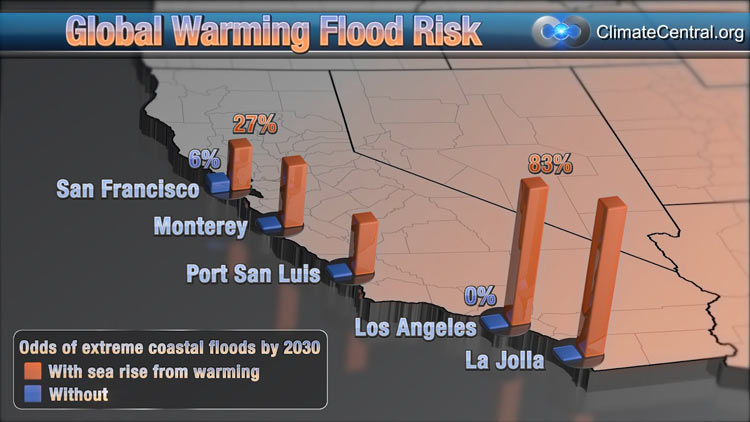
This map shows the odds of floods at least as high as historic
once-a-century levels, occurring by 2030,
based on Climate Central research. - See more here 

Sea level rise and related tide activity will impact bays and inland areas such as the Sacramento delta.  As the San Francisco Public Press special report points out, there continues to be a development boom along the San Francisco Bay waterfront with limited thought to the long term impacts of sea level rise:
"Developers say they have engineering and financial solutions to deal with any reasonable future flooding risk. But critics, including climate scientists, urban planners and environmental activists, say the current wave of construction might leave taxpayers on the hook for enormously expensive emergency protections and repairs."  San Francisco Public Press:  Major SF Bayfront Developments Advance Despite Sea Rise Warnings
The California legislature is in a concurrent special session right now to look at transportation issues.  It will be interesting to see how they link their transportation and climate change priorities.

Perhaps the best way to summarize the situation was provided last year in a report from the California Assembly Select Committee on Seal Level Rise and the California Economy:
"Sea-level rise has been called a slow-moving emergency. As a result, the future is not all doom and gloom since we have time on our side to prepare and plan for sea-level rise. Sea-level rise is not a surprise. We know it is happening and will only worsen. We must take advantage of the time we have to address this impending emergency now."  (Sea Level Rise: A Slow Moving Emergency, August, 2014)

Thursday, July 23, 2015

Tracking California Renewable Energy

As I write this post at mid-day on July 23, I can see online that the California electric grid is absorbing over 9,600 Megawatts of renewable energy, meeting 29% of current energy demand.  That's equivalent to the output of about nine major power plants.

July 23, 2015


I know this because a little known agency, the California Independent System Operator (ISO), posts near-instantaneous data about California electric supply and demand (here).  The ISO manages the flow of electricity over long-distance transmission lines for about 80% of California.  The numbers are lower than actual California renewable output since they don't include rooftop solar or some local renewable power generation.  As you'd expect, solar provides a substantial amount of electricity between 10 a.m. and 6 p.m. on a typical summer day:

Wednesday, July 22, 2015
Source:  California Independent System Operator

As more California renewables go online, ISO is regularly reporting new record amounts of solar production.  On June 19, they reported a peak amount of 6,217 MW of solar.  Less than a month later, on July 16, they reported a peak solar output of 6,329 MW.

Incorporating increasing amounts of renewables into the electric grid presents some interesting challenges, as I noted in my post about California 2030 renewable energy goals (here).  Assuring the maximum use of renewables in the future will require better coordination of energy supplies across the western U.S., more flexibility to curtail non-renewable power plants, and increased use of energy storage.  Below is a chart showing the amount of energy delivered from various sources on Wednesday, July 22.  Daily summary reports from the ISO on day-before and historical renewable output are available here.

Wednesday, July 22, 2015
Source:  California Independent System Operator

An interesting and innovative initiative of the ISO is to move towards allowing aggregation and grid-deployment of distributed generation sources such as rooftop solar and energy stored in electric vehicle or other batteries.  “With the rapidly evolving grid and quantum growth in distributed generation, this framework for integrating smaller renewable resources onto the high voltage grid demonstrates a significant step in re-designing our energy future with lower carbon emissions and helping California meet its clean energy goals,” said ISO President and CEO Steve Berberich. “This proposal encourages innovation and entrepreneurs to explore opportunities within the wholesale market by combining resources that individually would be too small to participate on their own.”  More information here and here.

If you want to see these sorts of cool graphs and data while out and about .. ISO has an app for that, ISO Today for Apple or Google Play.  I have to admit, I'm captivated by the information on my phone, including a map of renewable energy generation facilities.


Thursday, July 16, 2015

California 2030 Climate Goals: Renewable Energy


50% renewable energy by 2030 is another California climate goal that is reachable and replicable. The California Public Utilities Commission says the major utilities under their jurisdiction are already past 20% renewable and plan to surpass 30% renewable procurement by 2016 (report here).

Governor Jerry Brown set the 50% renewable goal for the electricity sector and getting there was the subject of a workshop held by his representatives recently. (Agenda/presenters here; available slides here)  The 50% by 2030 goal builds on the previously adopted "renewable portfolio standard" goal of 33% renewable use by 2020.

Challenges remain, including improving electricity storage, better interconnection among western electricity producers, better integration of renewables into the electric system and continuing to increase the pace of renewable deployment.


Workshop leaders included Senior Advisor to Governor Brown Cliff Rechtschaffen, California Energy Commission Chairman Robert Weisenmiller, CalISO President Stephen Berberich, PUC President Michael Picker, ARB Executive Offiser Richard Corey, PUC Commissioner Carla Peterman.

Cliff Rechtschaffen of the Governor’s Office explained that the 50% renewable electric goal is one of the “five pillars” of Governor Browns strategy to address climate change.   The other four include 50% reduction in petroleum use in vehicles (ClimateDispatch transportation workshop review here), doubling energy efficiency savings in existing buildings (ClimateDispatch efficiency workshop review here), carbon sequestration in soils and elsewhere, and reducing short-lived climate pollutants.
One of the workshop presenters, Dr. Nancy Ryan of E3 described four inter-related transitions that need to take place to meet the goals contained in the five pillars Mr. Rechtschaffen described.  The first is efficiency and conservation in energy use, transportation and urban design.  The second is fuel switching to electricity to electricity and hydrogen all sectors.  The third is decarbonizing electricity.  The fourth is decarbonizing fuels.

Source:  E3 Dr. Nancy Ryan presentation


Climate change is an issue “right now” in California, said Energy Commission Chairman Robert Weisenmiller.  “We need to move fast to reduce carbon.”  Weisenmiller pointed out that roughly 20% of California greenhouse gas emissions come from the electricity sector, with roughly half of those emissions coming from out of state facilities that provide power to California.   The amount of renewables needed will likely increase at a higher pace as the transportation sector becomes more electrified and there is greater electrification in other sectors.

California Public Utilities Commission Chairman Michael Picker stressed the importance of better interconnection and transmission capability for system reliability and to assure the access of renewables to the grid.  His comments were echoed by others.

The increased electricity demand could be especially dramatic after 2030, according to Dr. Nancy Ryan of E3.  She presented information from the “California PATHWAYS Project” completed last year by E3 for the AirResources Board, Energy Commission, Public Utilities Commission, California Independent System Operator and the Governor’soffice. The study shows electricity demand relatively stable through 2030, largely due to energy efficiency offsetting any increases in demand.  However, after 2030, the demand goes up, doubling or more by 2050, especially due to the decarbonization of the transportation sector through the introduction of renewable fuels and electrification.
Dr. Ryan said California is well positioned with the currently anticipated deployment of technologies and activities to meet the 2050 California goal of an 80% reduction in greenhouse gas emissions.  However, projections made in the PATHWAYS study suggest that more steps and accelerated deployment will be needed in the next few years to achieve the 40% reduction in 2030.  These projections contributed to the more aggressive goals announced by Governor Brown in his state of the state speech in January.  The need for additive actions was discussed in this workshop and the transportation and efficiency workshops.  The PATHWAYS study showed that without some acceleration in deployment and quicker technological advances, California would be on a trajectory to achieve between a 26% and 38% reduction by 2030, short of the desired 40%.


Though more will need to be done to achieve the overall 40% reduction by 2030, Dr. Ryan said that the electricity sector can meet the 50% renewable electricity goal.  She said that grid scale renewable additions are around 2,400 MW per year and that rooftop solar will account for almost 12,000 MW by 2030.

Source:  E3 Dr. Nancy Ryan presentation


Several presenters discussed the advances that have been made for electricity storage as well as the need to greatly expand available storage using current and improving technologies.  Dr. Ryan said that “deep draw” storage is critical – i.e. storage that can hold up to 8 hours of needed energy.  An example of existing “deep draw” technology is pumped storage where water from one reservoir is pumped to a higher reservoir during low demand times and then released to produce electricity during high demand times.  Emerging battery technologies also have the potential for greater storage.

Phil Pettingill, Regional Integration Director for the California Independent System Operator offered a series of suggestions for improving system efficiency to allow greater use of renewables.  (Cal-ISO – if you don’t know who they are, monitors and deploys electricity in real time to assure that enough electricity is purchased and available for use by the most of the California utilities)  Mr. Pettingill said there are times when renewables are producing too much electricity to be absorbed by the system given the amount of electricity coming from facilities that can’t easily reduce their output.    He offered a series of solutions, many of which were supported by other participants.  Among his suggestions:
  • Retrofit existing traditional power plants to allow them to be turned on, turned down or turned off more quickly.  Currently renewables often have to be curtailed because natural gas facilities can’t be turned down or turned off as needed.
  • Deepen regional coordination to share renewable resources.  Through better integration of power systems across the western states, it is believed that renewable energy can be more efficiently used.  For example, the peak production of solar in California may align with the peak electricity needs in Utah, while the peak wind production in another state may better align with the peak energy use in California.
  • Coordinate time of use rates with system conditions to more accurately reflect real market conditions.  Depending on the season of the year, the time of day for peak system energy use can vary by as much as 4 hours.  Assuring that time of use rates reflect seasonal and other variations may make rates more complicated, but for those who can effectively shift their use in response to pricing signals, the system benefits can be substantial.
Carl Zichella of the Natural Resources Defense Council agreed that a more coordinated regional electrical system is key to the success of renewables, especially as we move towards the 80% 2050 greenhouse gas reduction goal.  He pointed out that there are about 40 regional entities with responsibility for electricity sharing.

Mr. Pettingill of Cal-ISO gave an example of addressing the regional grid issues assuming 40% renewables in 2024.  In his example, better regional coordination in combination with other steps to eliminate renewable curtailment could reduce carbon emissions by as much as 1.5 million metric tons/year.

Source:  Cal-ISO presentation


Caroline Choi of Southern California Edison brought up the issue of distributed generation (DG) and said it should be counted towards the 50% renewables goal.  She said that her utility is getting 5,000 applications a month for rooftop solar and other DG connections and that DG will play a big role in renewable energy production in the future.  Dan Chia of Solar City said California is the only state that does not count rooftop solar towards their renewable portfolio.  Others, including Cesar Diaz of the Building and Construction Trades Council argue that the existing California policy is the right one and that rooftop solar installations should be counted in addition to, not part of, the utility renewable portfolio.

Mr. Diaz said the jobs impact of the California renewable transition has been impressive, with many quality jobs created in impoverished high-unemployment areas.  He also said that apprenticeship programs are helping thousands move into good jobs.

Source:  California Energy Commission


The Sacramento Municipal Utility District (SMUD) is one of the most progressive utilities in the country.  According to Arlen Orchard of SMUD, the utility is experimenting with microgrids, encouraging solar installations for customers and allowing customers who are unable to install their own renewables to pay a slight surcharge to assure all of their power is coming from renewables.  He also said that SMUD 2050 goal is even more aggressive than the California goal.  SMUD plans to cut greenhouse gas emissions by 90% by 2050.

The role of natural gas facilities is an issue.  Natural gas has been considered a fuel to help California transition to renewables.  It also helped California move more quickly out of dirtier in-state oil fired plants and imported coal fired electricity.  There is now discussion of how to move away from reliance on natural gas since natural gas is a major greenhouse contributor in the electric sector.  Laura Wisland of the Union of Concerned Scientists questioned why natural gas plants continue online in the middle of the day at times when renewables are available, and sometimes curtailed due to traditional plants being online.  She said the state needs to look carefully at the cost and value of gas plants versus storage and demand response alternatives together with renewable energy. 

About half of California GHG emissions from the electricity sector come from in-state sources and about half from out-of-state sources.  Most of the in-state GHG from the electric sector comes from natural gas facilities, as shown in the graphs below from the latest California GHG Emission Inventory:

Source: California Energy Commission


California Energy Commission Executive Director Rob Oglesby said his agency is funding a variety of research and development projects that will contribute to the renewable goals, including funding for advanced storage, demand response, better forecasting and microgrids.  PUC Commissioner Carla Peterman suggested better coordination between the PUC and Energy Commission on research needs and timing of deliverables to assure that PUC proceedings on utility actions fully benefit from Energy Commission funded research.

V. John White of the Coalition for Energy Efficiency and Renewable Technology said there are some high value higher cost renewables that could use more support from the state, including geothermal resources in Imperial County and methane from organic materials elsewhere in the state.  He also said more could be done to pursue large scale storage projects, including the PUC ordering utilities to evaluate storage options and report back on how they could pursue them.  He said the electric grid is key to renewable deployment and that a low carbon grid study will be coming out in early August that will detail the issue.

The commitment, creativity and resolve to meet the 2030 goal of 50% renewable energy is there in the California government, utility, business and NGO communities.  By moving noticeably closer to the goals each year, California is showing the world that decarbonization is politically, environmentally and economically viable.